 Skip to content


100% Cotton Dust Mite Pillow Protector & Encasement | Standard/Queen | AU
100% Cotton Dust Mite Pillow Protector & Encasement | Standard/Queen | AU
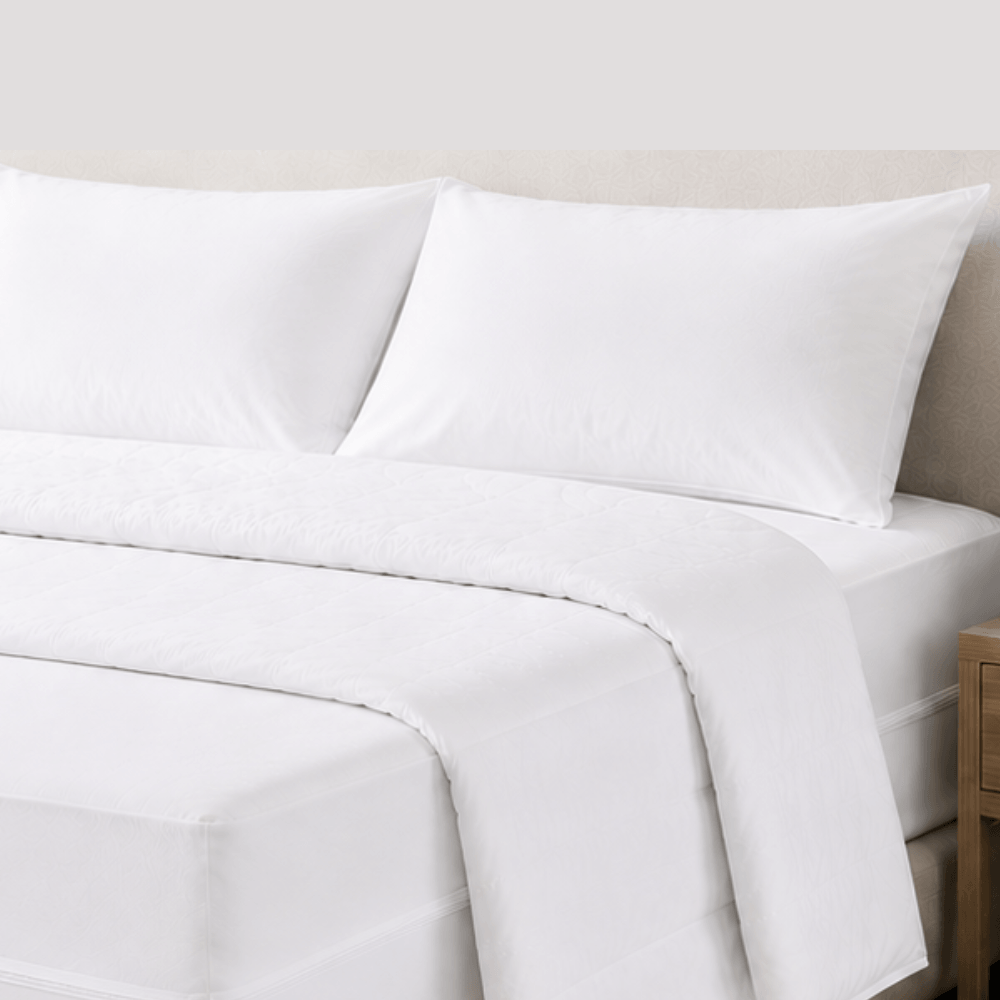
This tightly woven 100% cotton dust mite pillow protector zips your whole pillow inside a breathable barrier, so the build-up stays sealed away from you, night after night.
- Seals the whole pillow inside — zipped closed
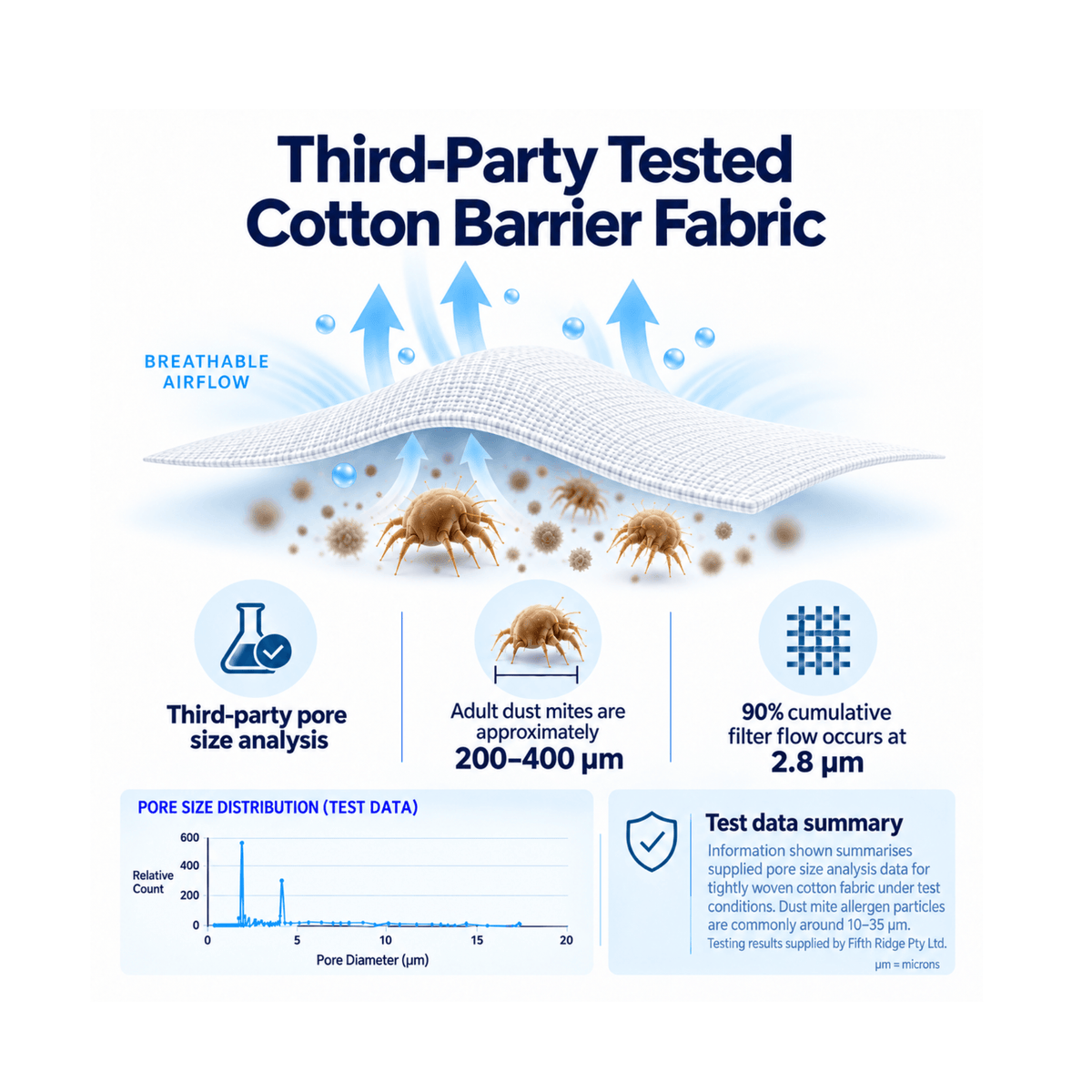
- Tightly woven 100% cotton, third-party pore-size tested
- Breathable, soft and quiet — no plastic layer
- Hypoallergenic and washable up to 60°C
Couldn't load pickup availability




100% cotton dust mite pillow protector
Allergy specialists recommend dust mite covers.
It’s on ASCIA’s list of practical steps for reducing dust mite allergen at home — and it’s the one that keeps working while you sleep.
ASCIA recommends covering mattresses, pillows and quilts with dust mite resistant covers.
ASCIA allergen minimisation guidance — the peak allergy body for Australia and New Zealand.
Encasings produced a significant long-term reduction in dust mite allergen over 12 months.
Randomised, double-blind controlled trial. Halken et al., 2003, Journal of Allergy and Clinical Immunology.
ASCIA, the peak body of allergy specialists in Australia, recommends dust mite covers as part of minimising exposure. Neither ASCIA nor the researchers cited endorse a particular brand.
Built as a barrier
Natural cotton. Serious barrier.
This isn’t a standard cotton cover. It’s tightly woven 100% cotton — a weave dense enough to be pore-size tested in a lab — with a full zip and sealed seams. No plastic layer.
Tight
Woven, not just cotton.
Fine woven fabric is what leading researchers name for dust mite covers — in testing, nonwoven fabrics let mites through.
360°
Zipped all the way closed.
The whole pillow sealed inside the barrier — not an open-ended or envelope-style cover.
2.7 µm
Lab-tested weave.
Third-party pore-size testing, with the full report available on request.
0
Raw seam edges. Sealed at the seams, not just the zip.
Seams are where cheaper covers leak. Ours are folded and bound closed, so the tight weave carries right to the edges.
100%
Cotton — hypoallergenic.
Breathable, soft and quiet — you’ll keep it on the bed because you won’t notice it.
What the research shows
Your pillowcase gets washed. The pillow inside doesn’t.
Leading dust mite researchers name fine woven fabric as “the correct material for pillow cases and for covers on duvets or comforters”, after tests with live mites showed nonwoven fabrics let mites through. That’s exactly what this protector is: fine, tightly woven cotton, zipped closed.
Wilson & Platts-Mills, 2018, Journal of Allergy and Clinical Immunology: In Practice.You wash the sheets.
Not the pillow.
Your face rests on your pillow for hours every night, and washing the pillowcase never reaches what’s built up inside the pillow.
The easier answer: zip it on once.
It works every night — no extra effort from you.
Why a standard protector isn’t enough
Standard pillow protector vs dust mite pillow protector.
A standard protector is made for spills and wear. A dust mite protector is made to be a barrier — and the difference is in the details.
| Standard pillow protector | This dust mite protector | |
|---|---|---|
| Fabric | Often quilted, terry or nonwoven synthetic | Tightly woven 100% cotton |
| Coverage | Often an open or envelope end | Zipped fully closed |
| Seams | Standard stitching | Enclosed binding seams |
| Pore size | Rarely tested or published | Third-party tested: most common 2.7 µm |
| Made for | Spills, stains and wear | A barrier against dust mite allergen build-up |
Tests with live mites showed mites can get through nonwoven fabrics, while fine woven fabric forms an effective barrier (Wilson & Platts-Mills, 2018). Read: dust mites in pillows — what helps ›
Tight weave. Tested, not guessed.
How small are the gaps in the weave?
Most of the tiny gaps between the threads are about 2.7 microns wide. A micron is one-thousandth of a millimetre — far too small to see.
In plain terms: the droppings that carry dust mite allergen are 4 to 15 times bigger than most of the gaps in this fabric.
Is it right for you?
Who this cotton dust mite pillow protector is for.
Made for you if…
- You’ve been told to reduce dust mites at home and want to start with the bed.
- You’ve tried washing and cleaning and want something that works every night without extra effort.
- You sleep hot and want natural, breathable cotton — not plastic.
- You want proof: a lab-tested weave, not just a promise.
Choose another option if…
- You need waterproofing for bed-wetting, spills or pets — choose our waterproof protector.
- You want the tightest barrier we sell (every pore under 1 micron) — also waterproof.
Less work than what you’re doing now
Fit it once. Then it just works.
From our customers
“Tight weave cotton.” That’s the point.
Reviews of our 100% cotton dust mite range.
“Made of a very nice tight weave cotton - no polyester which I detest in bedding. Really happy with my purchase”
Catriona R.“Love that these aren't plasticy and just cotton. Have gotten the entire set. Excellent products”
Holly R.“The cotton covers seem well made and fit as described, shipping is fast”
Belen B.Cotton or waterproof dust mite protector?
Both zip fully closed and are third-party pore-size tested.
Tightly woven cotton
This one
Waterproof
Our tightest barrier
Everything you get
More than a cover.
- ✓Tightly woven 100% cotton dust mite pillow protectorFull zip, enclosed binding seams, sealed on every side
- ✓Third-party pore-size test reportAsk us for a copy any time
- ✓12-month warrantyAgainst manufacturing defects, on top of your Australian Consumer Law rights
- ✓Free shipping over $150Australia-wide, dispatched in 1–3 business days
- ✓Real answers from a dust mite specialistNot sure on size or fabric? Email us before you buy
Bundle and save
Your pillow is one of three.
Protect the whole bed.
ASCIA recommends covering the mattress, pillows and quilt. The whole-bed bundle covers all three in matching tightly woven cotton, plus a Mattress Mate slip-on for easy weekly washing — and saves 10% on buying them separately.
Shop the whole-bed bundleTonight
Three steps. Then forget about it.
- 1Zip it on.Slide your pillow in and zip it closed. Done in seconds.
- 2Make the bed.Your normal pillowcase goes straight over the top and gets washed weekly as usual.
- 3Sleep.Wash it every couple of months. That’s the whole routine.
Step one of a proven plan
Start with the bed. Then build on it.
A 2018 review by allergy researchers at the University of Virginia describes combining several measures as more likely to succeed than any single step (Wilson & Platts-Mills). Covers are a sensible place to start. Here is what the research says works alongside them.
Encase the bed and hot-wash weekly.
Covers on the mattress, pillows and quilt. Research found water at 55°C or above was effective at reducing dust mite populations in bedding (McDonald & Tovey, 1992).
Shop bundles ›Keep humidity below 50%.
Homes kept below 51% humidity for 17 months had 98% fewer live dust mites (Arlian et al., 2001).
Dehumidifiers ›Vacuum with a HEPA filter.
In a real-home study, intensive HEPA vacuuming cut dust mite allergen in carpets by about 81% (Yu et al., 2009).
HEPA vacuums ›Clean the air.
HEPA air cleaners are on leading researchers’ priority list for dust mite reduction (Wilson & Platts-Mills, 2018).
Air purifiers ›Findings are from the cited studies and describe the methods tested, not specific products. See the full step-by-step guide ›
Cotton dust mite pillow protector questions.
Do dust mite covers work?
The evidence is strong. ASCIA recommends covering mattresses, pillows and quilts with dust mite resistant covers, and a 12-month randomised controlled trial found mattress and pillow encasings produced a significant long-term reduction in dust mite allergen (Halken et al., 2003). They work best fully zipped, in a tightly woven fabric, alongside weekly hot washing of sheets.
Do pillow protectors stop dust mites?
No cover can promise that, and a standard pillow protector isn’t built for it. A dust mite pillow protector is different: it zips the whole pillow inside a tightly woven barrier fabric, so dust mite allergen built up inside the pillow stays sealed in. This one is tightly woven 100% cotton with a most common pore size of about 2.7 microns.
Why does a dust mite pillow protector need a zip?
An open or envelope end leaves a gap. A zip closes the pillow in completely, so the barrier has no open side.
Which materials are best for dust mite covers?
Fine, tightly woven fabric. Leading researchers name fine woven fabric as the correct material for dust mite covers, after tests showed mites can get through nonwoven fabrics (Wilson & Platts-Mills, 2018). Our two options are tightly woven 100% cotton (breathable) and a knitted jersey with a TPU membrane (waterproof, every pore under 1 micron).
Is it suitable for sensitive skin?
It’s hypoallergenic 100% cotton, with no plastic layer, so it feels and breathes like good bedding. Wash it before first use. If you have a diagnosed skin condition, check with your GP or dermatologist.
Does a zippered protector feel tight or noticeable?
It’s made to fit snugly so there are no loose folds, but under a pillowcase the soft, quiet cotton isn’t noticeable — no crinkle and no plastic feel.
How often should I wash it? Should I wash it before use?
Yes, wash it before first use. ASCIA recommends washing dust mite covers at least every two months; your pillowcase on top gets washed weekly as usual. Wash straight away after a spill. Wash with the zip closed. Warm or gentle cycle, no hotter than 60°C, and skip bleach and fabric softener.
How long does it last, and when should I replace it?
Replace it when the fabric tears or wears thin, or the zip no longer closes fully — a gap means the barrier is broken. Washing on a warm or gentle cycle and avoiding bleach helps it last.
Cotton has pores up to 23 microns. Is that a problem?
Most of the cotton’s pores sit around 2.7 microns and its average is about 5.6 microns, under the 10-micron average that lab research linked to blocking dust mite allergen. If you want every pore under 1 micron, choose our waterproof protector.
Will it make me hot?
It’s the coolest protector we sell. Tightly woven cotton still breathes, so air and moisture vapour pass through.
Tech specs
| Fabric | Tightly woven 100% cotton, hypoallergenic |
|---|---|
| Most common pore size | About 2.7 microns (third-party capillary flow porometry) |
| Mean flow (average) pore size | About 5.6 microns |
| Largest detected pore | About 23 microns |
| Size | Standard/Queen, 50 × 75cm |
| Closure | Full-length zip along one short end, enclosed binding seams |
| Warranty | 12-month voluntary warranty against manufacturing defects, in addition to your Australian Consumer Law rights. Refund Policy |
| Shipping | Australia only. Free over $150. |
Small print
Not a medical product. We don’t claim this product cures, treats, prevents or relieves allergies, asthma or any medical condition. We describe the fabric’s measured physical properties as a barrier. If you have a diagnosed condition, talk to your GP or allergist.
Hypoallergenic isn’t a regulated term for textiles. We use it to mean 100% cotton with no plastic or synthetic layer.
Testing. Pore-size figures are from a third-party laboratory test report provided by our manufacturer; a copy is available on request. They describe the fabric, not a guarantee of allergen reduction.
Research (ASCIA; Halken et al., 2003; Wilson & Platts-Mills, 2018; Visitsunthorn et al., 2010; Vaughan et al., 1999; McDonald & Tovey, 1992; Arlian et al., 2001; Yu et al., 2009) is cited as findings of those sources about covers and methods in general, not claims about this product.
Browse all dust mite pillow protectors or every dust mite cover we stock.