 Skip to content



Dustmiteallergysolutions
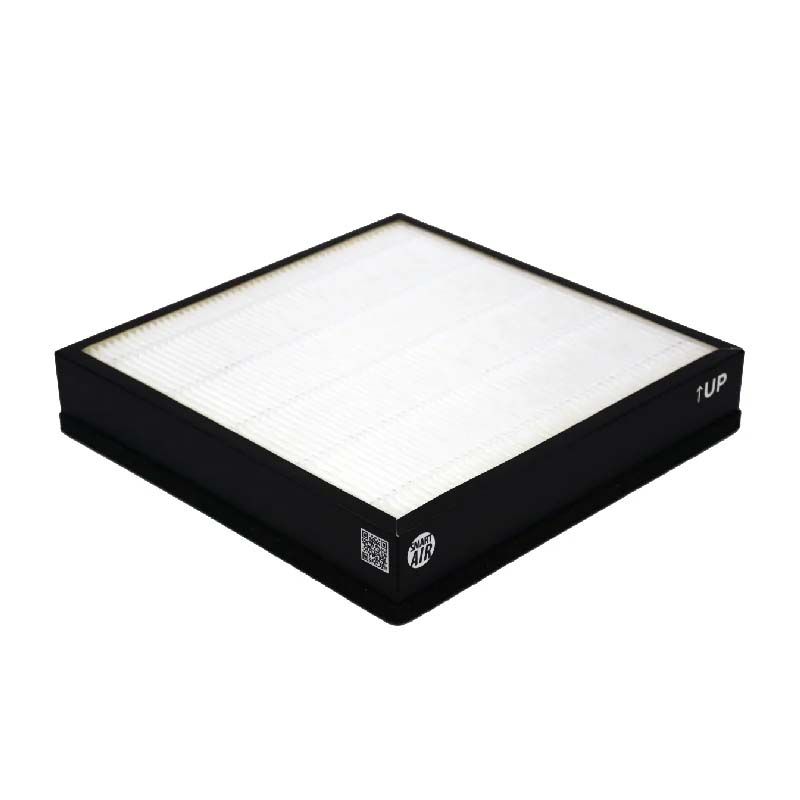
SmartAir Sqair Replacement HEPA Filter
SmartAir Sqair Replacement HEPA Filter
Couldn't load pickup availability
The replacement H12 HEPA filter for the SmartAir Sqair air purifier — a wear part designed to be swapped approximately every 6 months under normal household use. Sqair air purifier compatibility only.
Who it's for
Existing Sqair owners replacing a saturated filter. Air purifier filters are consumable wear parts: as the filter loads up with particulate, airflow drops, the unit works harder, and effective CADR drops. Replacing the filter on schedule keeps the Sqair operating at its rated specification.
Key features and specifications
- Filter grade: EN 1822 H12 (also referred to as E12 under post-2009 EN 1822 reclassification) — captures ≥99.5% of airborne particles at MPPS (the most penetrating particle size, around 0.1-0.3 microns)
- Filter media: polypropylene (PP) + polyester (PET)
- Surface area: 1.55 m² (equivalent to ~22 sheets of A4 paper)
- Lifespan: approximately 1,400 hours, or about 6 months at 8 hrs/day under typical household conditions
- Approximate dimensions: 5 × 27 × 27 cm
- Compatible with: SmartAir Sqair air purifier (not compatible with QT3, SA-600, Blast, or Blast Mini)
Why H12 (not H13)
The Sqair uses H12 by deliberate Smart Air engineering choice. Tests across multiple HEPA grades found H12 produces more total clean air than H13 in this fan/filter geometry, because H12 has lower air resistance — the fan can move more air through the filter at lower noise. H12 captures ≥99.5% at MPPS; H13 captures ≥99.95%. For a small-room overnight purifier, the H12 design produces more total clean air than the same unit with H13 would.
How it works
The filter captures fine particles by three mechanisms simultaneously:
- Inertial impaction — large particles (>1 micron) hit fibres directly and stick
- Interception — medium particles follow airflow but contact fibres on curves
- Brownian-motion diffusion — very fine particles (<0.3 microns) bounce randomly and contact fibres regardless of airflow path
The diffusion mechanism is what allows HEPA filters to capture particles smaller than 0.3 microns — including respiratory aerosols carrying viruses or bacteria. CDC and academic research on HEPA filtration of fine particulates and bioaerosols is publicly available.
What it doesn't do
This is an air purifier filter, not a medical device. We don't make claims about treating any health condition.
FAQs
Can I wash the filter to extend its life? No — Smart Air explicitly recommends against washing. Their own testing showed that water wash actually reduces filter performance rather than extending it. The HEPA fibre media isn't designed to be wetted; replace rather than wash.
How do I know when to replace? Smart Air's general guidance is approximately 1,400 hours of runtime (about 6 months at 8 hours of daily use). Heavier use compresses the interval; cleaner local air may extend it. Visual signs include reduced airflow, noticeable noise increase at the same fan speed, or the filter material appearing visibly grey/discoloured.
How is it different from H11 or H13 filters? H11 captures ≥95% at MPPS; H12 (this filter) captures ≥99.5%; H13 captures ≥99.95%. The grade is set by EN 1822 — Europe's standard for HEPA filter testing. H12 is the standard fitted to the Sqair; you can't substitute H11 (lower grade, wouldn't fit the housing properly) or H13 (different airflow characteristics, may impact CADR). For a True HEPA H13 filtration option, look at the SA-600, Blast Mini, or Blast purifier ranges.
What's the difference between H12 and E12? None — they're the same filter. EN 1822 was revised in 2009; what was previously called H12 is now technically classified E12 ("EPA" rather than "HEPA," with HEPA classification starting at H13 under the revised standard). Smart Air uses both terms across their global sites; your filter is the same product either way.
Does it remove odours, smoke, or VOCs? No — HEPA filters capture particles. For odours, smoke, and VOCs you need an activated carbon filter. The Sqair's optional carbon filter (sold separately) sits ahead of the HEPA in the unit and adsorbs gas-phase pollutants.
Does it filter viruses? HEPA filters in this class capture virus-laden respiratory aerosols by the same diffusion mechanism that captures other fine particles. We don't make specific clinical claims about disease transmission — the underlying mechanism is well-documented in CDC and academic research, but the magnitude of effect in any specific space depends on room size, air-change rate, occupancy, and other factors.
Will it fit other Smart Air models? No — this filter is sized specifically for the Sqair housing. The QT3 (smaller), SA-600 (different geometry), Blast Mini, and Blast all use different filters. Check our filter range for the model you own.
How do I install it? Open the Sqair from the bottom (the legs unscrew), lift out the old filter, place the new filter in the same orientation (arrow markings on the filter side indicate airflow direction — these should point away from the fan inlet), and reassemble. Total time about 30 seconds.
Care notes
Don't wash. Replace approximately every 6 months at 8 hrs/day, or sooner if airflow noticeably reduces. Dispose of used filter in general waste — there are no hazardous components.


Let customers speak for us
Fits a standard Koala foam pillow extremely well. Made of a very nice tight weave cotton - no polyester which I detest in bedding. Really happy with my purchase

The cotton covers seem well made and fit as described, shipping is fast

I would suggest this mattress and cover as a perfect solution to dust mite, also with regards to comfort it’s just what you need

I have not been able to sleep under a feather doona until now. The cover is wonderful & delivery was prompt.

Bought to remove neighbours' wood heater smoke from bedroom, works well, haven't checked out cost of replacement filters. Quick delivery, no issues.

Great quality, quick delivery and comfortable
Quick delivery, easy to setup and works great

This mattress encasement is a great solution and alternative to purchasing a new mattress for a child with dust mite allergy. The protected went on easily and provides leave of mind that whatever mites are living inside the mattress are trapped in there. Have purchased all of the products to protect our kids bed and are happy with them. Have been using for over one month now.

The quilt cover encasement feels like it's great quality. Have been using for about one month now and it's providing peace of mind that whatever is inside there can't get out. Washing the quilt weekly was not going to work as the quilt wouldn't have survived such regular washing, so this is an excellent solution.
Great quality cotton material, but it's a bit of a struggle to get onto the mattress.

Great quality cotton material, but it's a bit of a struggle to get onto the mattress.
The product is great quality and was an easy order with very good communication. I have only had one night sleeping with it but was very pleasantly surprised . I must add , I think the cost is great value when compared to getting even a new doona that is adequate for the colder states in Australia . I had my down doona and pillows washed and commercially dried before putting them in the covers and the mattress is all encased now and it is a really big difference . 👍
Efficient postage, easy to put onto the mattress, duvet etc. Daughter finds it comfortable and soft.
Efficient postage, easy to put onto the mattress, duvet etc. Daughter finds it comfortable and soft.
We purchased mattress , pillow and duvet encasement for kids due to their dust mite allergy.
Quality is great and delivery was earlier than expected.