Skip to content


If you're managing dust mite allergies, the air in your bedroom is your most important environment. You sleep in it for a third of every day, often with the door closed, the windows shut, and the same upholstered surfaces collecting allergen night after night.
An air quality monitor doesn't fix any of that — but it tells you what's actually happening. And once you can see the numbers, decisions about ventilation, dehumidification, and filtration stop being guesswork.
This guide walks through what indoor air quality monitors measure, what those readings mean for an allergy household specifically, and how to choose one that's accurate enough to act on.
Why indoor air matters more than outdoor air
The WHO estimates that people in developed countries spend roughly 90% of their time indoors. For young children, the elderly, and anyone working from home, that figure is often higher. Indoor pollutant concentrations can be 2–5 times higher than outdoor levels, and occasionally much higher than that — particularly in well-sealed modern homes where airflow is limited.
For dust mite allergy households, three indoor factors matter most:
-
Humidity
— dust mites thrive at relative humidity above 50%. They can't drink water; they absorb moisture from the air. Drop the RH below 50% and the population stops growing. Drop it below 40% and the population starts to die back. This is the single most actionable lever in dust mite control, and the only way to know your humidity is to measure it. -
Particulate matter (PM2.5 and PM10)
— fine and coarse particles include dust, dust mite fragments, pollen, mould spores, cooking smoke, and pollution that infiltrates from outside. -
Ventilation (measured indirectly by CO₂)
— closed rooms trap humidity and allergens. CO₂ rises when ventilation is poor, which is also when humidity and PM tend to climb.
A monitor that covers humidity, PM2.5, and CO₂ gives you almost everything you need to manage a dust mite-prone home.
What an air quality monitor actually measures
Different monitors track different things. Here's what each metric tells you.
PM2.5 — fine particulate matter
PM2.5 refers to airborne particles 2.5 micrometres or smaller. They're small enough to bypass your nose and throat's filtering and lodge in lung tissue. The WHO classifies long-term PM2.5 exposure as a leading environmental health risk globally.
Indoor sources include cooking (especially frying and gas cooktops), candles, fireplaces, smoking, vacuuming, and outdoor pollution that infiltrates through windows and door gaps. For allergy households, PM2.5 readings also confirm whether your HEPA air purifier is doing its job — if PM2.5 stays low when you run the purifier and climbs when you turn it off, that's your evidence.
Useful threshold: WHO 2021 guideline is 15 µg/m³ average over 24 hours. Anything consistently above this is worth addressing.
PM10 — coarse particulate matter
PM10 covers particles up to 10 micrometres — large enough to include visible dust, pollen, and mould spores. It's the metric most relevant to pollen-allergy sufferers and to households where dust accumulation is a concern. PM10 is captured by the same laser-scattering sensors that measure PM2.5, so any monitor with PM2.5 will usually include PM10.
Humidity (relative humidity, %)
For dust mite households, humidity is the single most important reading. ASCIA and international allergy bodies consistently recommend keeping bedroom humidity below 50% for dust mite control. In Australia's east-coast climate — Sydney, Brisbane, the Gold Coast, much of Queensland — outdoor humidity routinely sits above 70% in summer, and indoor RH follows unless you actively manage it with air conditioning or a dehumidifier.
A monitor with an accurate humidity sensor is non-negotiable. It tells you when to run your dehumidifier, when to close windows, and whether your bedroom is in the dust-mite-friendly or dust-mite-hostile zone.
Useful threshold: target 40–50% RH for allergy management. Below 30% can feel uncomfortable and irritate respiratory passages; above 60% supports mould as well as dust mites.
CO₂ — carbon dioxide
CO₂ isn't a pollutant in the indoor concentrations homes typically see — it's a proxy for ventilation. Outdoor air sits around 420 ppm. When CO₂ in a closed bedroom climbs to 1,500 or 2,000 ppm overnight, that tells you the room isn't exchanging air with outside — which usually means humidity is also building up, and allergens are concentrating rather than dispersing.
Published research on classroom air quality has linked CO₂ levels above 1,000 ppm to measurable reductions in concentration and cognitive performance. Levels above 2,000 ppm are commonly associated with drowsiness and headaches.
The fix for high CO₂ is almost always ventilation — opening a window, running an exhaust fan, or improving HVAC airflow. It's not filtration.
TVOC — total volatile organic compounds
TVOC is a catch-all for gas-phase pollutants: formaldehyde (classified by IARC as a Group 1 known human carcinogen), benzene, solvents, and the various organic chemicals that off-gas from new furniture, fresh paint, cleaning products, and personal care items.
VOC spikes are typically short-lived. Spray a cleaning product, watch the TVOC climb; ventilate for ten minutes, watch it fall back down. This is the most "exciting" reading to watch but also the most situational. If you're not bringing new furniture into the house regularly or using strong cleaning products, TVOC won't change your daily decisions much.
For allergy households where chemical sensitivities overlap, or for parents bringing a new cot or mattress into a nursery, TVOC monitoring is genuinely useful. For everyone else, it's a "nice to have."
Temperature
Most monitors include temperature because the same sensor measures humidity. Useful for sleep comfort and for tracking whether a room is warm enough for mould to thrive (mould prefers warm + humid).
Sensor types — why this matters more than you'd think
Two monitors can show wildly different readings of the same air. The reason is almost always sensor quality. Here's what to look for.
Laser-scattering (for PM2.5 and PM10)
A laser shines through a sample chamber and detects particles by how they scatter light. This is the right sensor type for particulate matter. Quality laser sensors hold their accuracy for years; cheap ones drift quickly.
NDIR — non-dispersive infrared (for CO₂)
NDIR is the industry-standard CO₂ measurement method. It uses an infrared beam absorbed by CO₂ molecules, with no chemical degradation over time. This is the only CO₂ sensor type worth buying. The cheaper alternative is "estimated CO₂" derived from VOC readings — these are unreliable and you should avoid any monitor that uses them.
Photoacoustic NDIR
A more advanced NDIR variant that's smaller and more stable. Sensirion's SCD40 is the most common example and appears in higher-end monitors.
Electrochemical and metal-oxide (for VOCs)
TVOC sensors are less mature than PM and CO₂ sensors. They drift over time, they cross-react with humidity, and absolute accuracy is poor. The best you can expect is a directional signal — TVOC went up or down — not a precise number. Sensirion's SGP4x series with humidity compensation is among the better implementations.
Capacitive (for humidity) and resistive thermistor (for temperature)
These are mature, well-understood sensors. Quality manufacturers like Sensirion publish individual datasheets per sensor. The SHT4x family complies with RESET®, WELL Building Standard™, and UL 2905 — the certifications used in commercial green-building specifications.
The shortcut: monitors using Sensirion sensors for CO₂, humidity, and VOC are reference-quality. Monitors that don't specify their sensor manufacturer typically aren't.
Why a standalone monitor beats your air purifier's built-in sensor
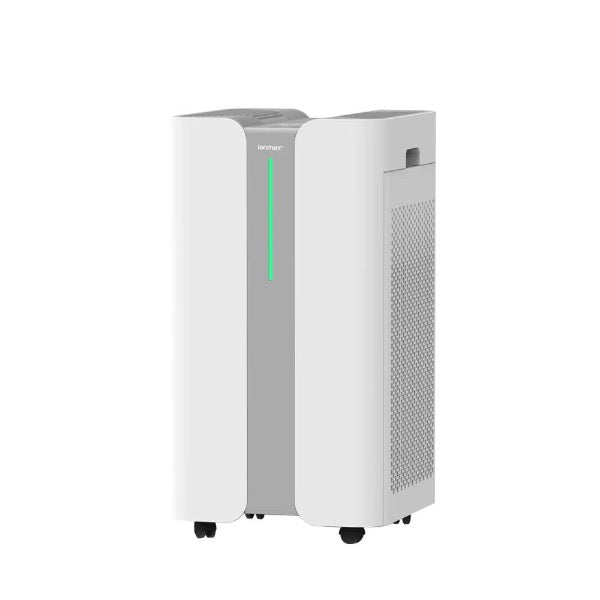
Many air purifiers come with built-in PM sensors. These are useful for the purifier's auto-mode logic but they're a poor source of truth for your actual breathing zone, for two reasons:
- Placement. The sensor is in the purifier's air intake — measuring the dirtiest air in the room, the air heading into the filter. That's not what you're breathing.
- Accuracy. Built-in sensors are typically the cheapest component of the purifier. They're rarely the laser-scattering laboratory-grade sensors used in standalone monitors.
A standalone monitor at desk or bedside height — at breathing zone, away from the purifier's intake — gives you a much truer reading. Pairing the two is the standard approach: the monitor tells you what your air is doing; the purifier responds.
Where to place a monitor
Placement matters more than people expect. Best practice:
- Breathing height — 1 to 1.5 metres above the floor. Bedside table, desk, kitchen counter. Not on the floor (PM stratifies vertically) and not on a high shelf.
- In the room you actually use most. If you spend evenings in the living room and nights in the bedroom, you ideally want monitoring in both. One monitor is fine; rotate it if you're trying to characterise a multi-room problem.
- Away from direct airflow. Don't park it under an air-conditioning vent or in front of a fan — you'll get distorted PM readings.
- Away from heat sources and cooking surfaces. Direct heat skews temperature; cooking creates localised PM spikes that don't represent the rest of the room.
- Away from windows. Outdoor air influxes will dominate the readings rather than your indoor environment.
For dust mite households specifically, the bedroom is the priority location — that's where humidity matters most and where you spend the most continuous time.
App, smart home, and the HomeKit question
Most modern monitors offer some combination of:
- On-device display only — the simplest option. Look at it, read the number.
- Phone app connectivity — historical data, trend graphs, custom alerts. Useful for understanding patterns ("CO₂ climbs every night between 1 and 4 AM").
- Smart home integration — the monitor can trigger other devices. If PM2.5 crosses a threshold, the air purifier switches on automatically; if CO₂ climbs, a fan starts.
The major smart home ecosystems are Apple HomeKit, Google Home, and Xiaomi Mi Home. Compatibility varies by monitor. If you're an Apple household, HomeKit integration is genuinely useful — air quality data appears directly in the iOS Home app, Siri responds to voice queries, and automations are easy to set up.
The trade-off: HomeKit-compatible monitors are a small subset of the market. In the Qingping range, only the Lite model supports HomeKit natively; the Gen 2 (Pro 2) connects only via the Qingping+ app and Mi Home. If HomeKit matters to you, this narrows your choice significantly.
Accuracy and calibration
Two things determine whether you can trust a reading:
Absolute accuracy — how close the number is to a reference measurement. For PM2.5, ±10% is excellent; ±20% is acceptable for home use; worse than that and you're guessing.
Drift over time — sensors degrade. CO₂ NDIR sensors with auto-calibration can hold accuracy for years; budget VOC sensors can drift noticeably within twelve months.
Smart Air, the company behind the Qingping range internationally, has published independent comparison testing of their monitors against government-grade reference stations. Over a 17-day measurement window, their Lite and Pro monitors tracked closely with official readings — in some cases more accurately than commercial monitors costing fifty times more. That's the kind of third-party validation worth looking for.
Our recommendation: the Qingping range
We stock two Qingping monitors in our Air Quality Monitors collection:
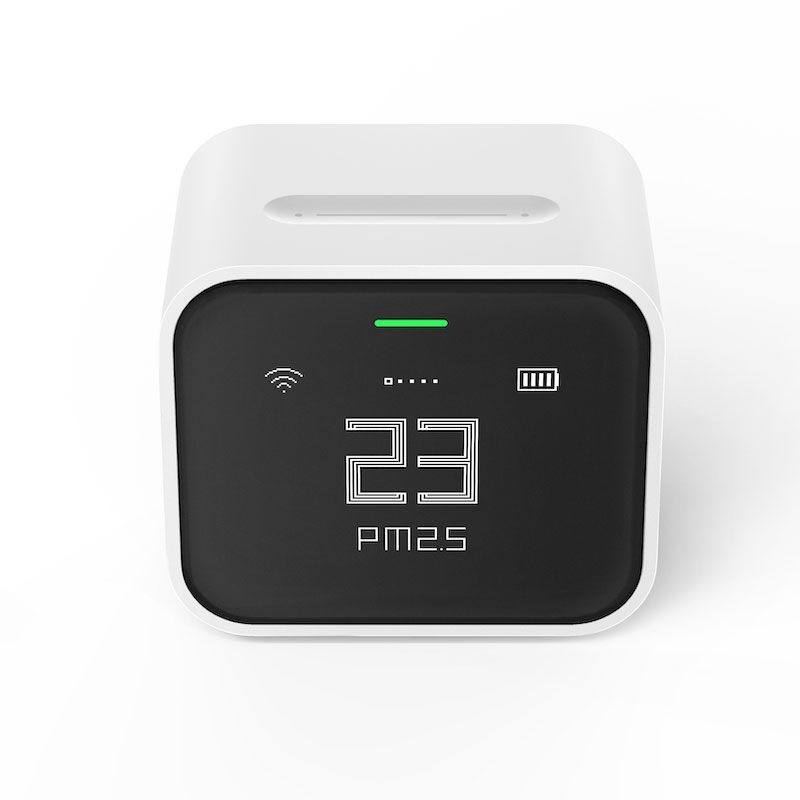
- Qingping Lite Air Quality Monitor ($149) — 5-in-1, native Apple HomeKit, compact and portable. The right choice for most allergy households who want PM2.5, CO₂, temperature, and humidity in a clean package.
- Qingping Air Monitor Gen 2 (Pro 2) ($245) — 7-in-1, adds TVOC, ambient noise, and a 4-inch IPS touchscreen with outdoor AQI snapshot. The right choice if VOCs matter to you or you want a single statement piece on the living room sideboard.
Both use laser-scattering PM sensors, NDIR CO₂ sensors, and Sensirion-grade humidity sensors. Both are independently tested by Smart Air against reference monitors. Both work with the Qingping+ app and the Xiaomi Mi Home ecosystem.
The Lite is the recommendation for most dust mite households. The Gen 2 is the upgrade pick if you want VOC tracking or whole-home reference accuracy.
Once you've measured, what next?
Monitoring is step one. Acting on the readings is step two. The standard responses:
- High humidity (>50% RH) → dehumidifier, or run air conditioning in dry mode, or improve ventilation if outdoor air is drier.
- High PM2.5 → HEPA air purifier sized to the room, plus identifying the source (cooking, candles, outdoor infiltration).
- High CO₂ → open a window or improve mechanical ventilation. Filtration won't help with CO₂.
- High TVOC → ventilate, identify the source (new furniture, cleaning products, paint), consider a carbon-filter air purifier if VOCs are chronic.
- Persistent dust mite symptoms despite controlled humidity → look at allergen-proof bedding covers and HEPA vacuuming, since covers and filtration address exposure even when humidity is well-managed.
A note on health claims
Air quality monitors are measurement devices, not medical devices. They don't diagnose anything; they don't treat anything. The readings help you make informed decisions about ventilation, filtration, and dehumidification — decisions that can make your home environment less favourable for dust mites and reduce the particulates you're exposed to indoors.
If you're managing a specific health condition that's sensitive to indoor air quality — diagnosed asthma, severe allergies, chemical sensitivities — please discuss your environment with your GP or specialist. They're best placed to advise on your specific situation. This guide is general information, not medical advice.
Sources and further reading
- World Health Organization — Air quality guidelines (2021)
- ASCIA — House dust mite allergy
- IARC — Classification of formaldehyde as Group 1 carcinogen
- Sensirion — published sensor datasheets and certifications (RESET, WELL, UL 2905)
- Smart Air — independent comparison testing of Qingping monitors vs reference stations
Last updated: May 2026. Written for Australian dust mite allergy households by the team at Dust Mite Allergy Solutions, Brisbane.